
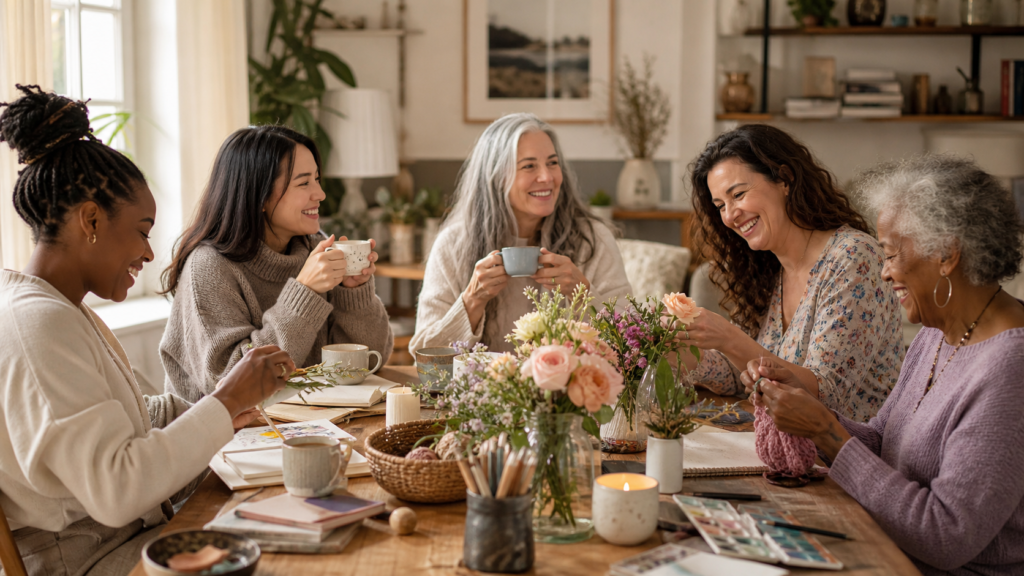
Becoming Whole Again: Art, Rest, and Friendship for Women Who Lead
Art Gives Us a Place to Be Human
There is a particular kind of woman who carries a lot. She owns the business, answers the emails, remembers the field trip form, plans the campaign, teaches the lesson, checks on the friend who has been quiet, and still somehow makes dinner appear. She is often the one people count on to keep the room steady.
Business owners, mothers, teachers, marketers, caregivers, leaders, volunteers, community-builders — many women move through life as the person who makes things happen. They are creative, capable, and deeply committed. They want to show up well for their families, their clients, their students, their teams, and their friends. Yet even the most generous women need places where they are not performing, producing, managing, or holding everything together.
Many women need art. Downtime matters too. Friend groups where they can exhale are essential. These are not luxuries—they are vital practices for becoming whole again and for building a full, sustainable life.
How Art Helps Us Become Whole Again
Art has a way of reaching the parts of us that responsibility can crowd out. For women whose days revolve around tasks, deadlines, and care for others, creativity can feel impractical at first. Painting, music, writing, dancing, photography, pottery, gardening, design, cooking, decorating, and storytelling may not always look “productive” in the traditional sense.
However, art accomplishes something productivity cannot. It gives us a place to feel without needing to explain. Moreover, it helps us process what we have been carrying. We discover we are more than our roles, more than our calendar, more than the needs we meet for everyone else.
Consider the woman who spends all day making decisions; she may need to sit with color and texture instead. A teacher who pours out energy for students may need to write one honest page. A mom who has been touched, needed, and interrupted all day may need music in the car with no one asking anything of her. Meanwhile, a business owner who constantly solves problems may need to make something that does not have to become content, revenue, or a deliverable.
Ultimately, art reconnects us with wonder. It makes room for grief, joy, curiosity, play, and imagination. It lets us hear ourselves again—a critical step in becoming whole again after seasons of self-abandonment.
Downtime Is Not Wasted Time
Many women have internalized the belief that rest must be earned. Finish the work first. Clean the house first. Send the proposal first. Fold the laundry first. Make sure everyone else is okay first. Yet there is always another “first.”
Without intentional downtime, life becomes a long list of demands with no room to recover. When recovery disappears, even meaningful work starts to feel heavy. Therefore, downtime is not laziness—it is maintenance. It restores the nervous system, lets the mind wander, and allows the soul to catch up with the body.
For women who are constantly visible or responsible, downtime may need to be almost stubbornly protected. Consider: a quiet walk, a slow morning, a screen-free evening, sitting outside with coffee, reading something unrelated to self-improvement, taking a nap without guilt, driving in silence, or letting an afternoon remain unoptimized. In practice, these moments may not look impressive from the outside, but they restore the inner spaciousness required to love people well.
A woman cannot keep making room for others if there is no room left inside herself. This is why becoming whole again requires us to defend our rest, not apologize for it.
Friend Groups Remind Us We Are Not Alone
There is something powerful about being with people who do not need the polished version of you. Friend groups can be a lifeline, especially for women who lead, nurture, and serve in multiple spaces. Not every friendship has to be deep in the same way, but every woman needs circles where she can be honest—places where laughter comes easily, where someone notices when she is tired, and where the question “How are you?” is not just a greeting.
For business owners, friendship softens the loneliness of leadership. For mothers, it brings relief from the myth that everyone else has it figured out. For teachers, it offers comfort after days spent caring for a room full of needs. Marketing professionals and creatives find grounding in a world that often rewards constant output and comparison.
Good friends help us remember who we are underneath the roles. Additionally, they celebrate wins that others might not understand. They say, “That sounds hard,” without immediately trying to fix it. They make ordinary life feel lighter. Importantly, sometimes they give us permission to rest before we would have given it to ourselves.
The Women Who Hold Space Need Space Too
Women are often praised for their ability to hold space for others. Their capacity to listen, anticipate, organize, and soften the edges of difficult moments is remarkable. They remember birthdays, manage emotions, mentor younger colleagues, create beautiful experiences, and help people feel seen. Yet that kind of presence is also energy—and it requires replenishment.
To keep showing up with compassion, patience, creativity, and steadiness, women need places where they are not only giving. Instead, they need places where they receive. Art offers that. Downtime offers that. Friendship offers that.
These practices are not separate from leadership, motherhood, teaching, business, or service. Rather, they support those things. In short, they help women return to their lives with more clarity, more tenderness, and more capacity—which is what becoming whole again truly means.
Making Room Without Making It Complicated
The answer is not always a dramatic life overhaul. Most women do not need one more impossible standard to meet. Instead, the shift often begins with small, honest choices.
Take one evening a month for dinner with friends. Keep a sketchbook nearby. Sign up for a class with no goal of becoming excellent. Walk without listening to a podcast. Schedule rest before the calendar fills. Ask a friend to come over even when the house is not perfect. Choose beauty for its own sake. Let joy be reason enough.
The point is not to add more pressure. Rather, the point is to make room for what restores us. A full life is not just one filled with responsibility. Instead, it is also filled with connection, beauty, laughter, quiet, and play. Research from Harvard Medical School documents the long-term health benefits of rest and meaningful relationships, showing how creative practices and social connection support wellbeing and help us sustain becoming whole again.
A Different Kind of Success
For women who are building businesses, raising families, teaching classrooms, creating campaigns, leading teams, and loving their communities, success cannot only be measured by output. Instead, it must also be measured by aliveness.
Are we still able to notice beauty? Are we laughing with people who know us? Are we creating without needing to monetize it? Are we resting before we break? Do we allow ourselves to be held, not just needed?
The world benefits from women who are capable and committed. But it also needs women who are nourished, connected, imaginative, and whole. Modern psychology explores wholeness in human development extensively, emphasizing integration of rest, creativity, and community as core to sustainable wellbeing and to the ongoing work of becoming whole again.
Art, downtime, and friend groups help make that possible. They give women back to themselves. And from that place, they can show up for others—not as depleted versions of who they used to be, but as women with space, softness, strength, and joy still alive within them. This is what becoming whole again looks like in practice.