
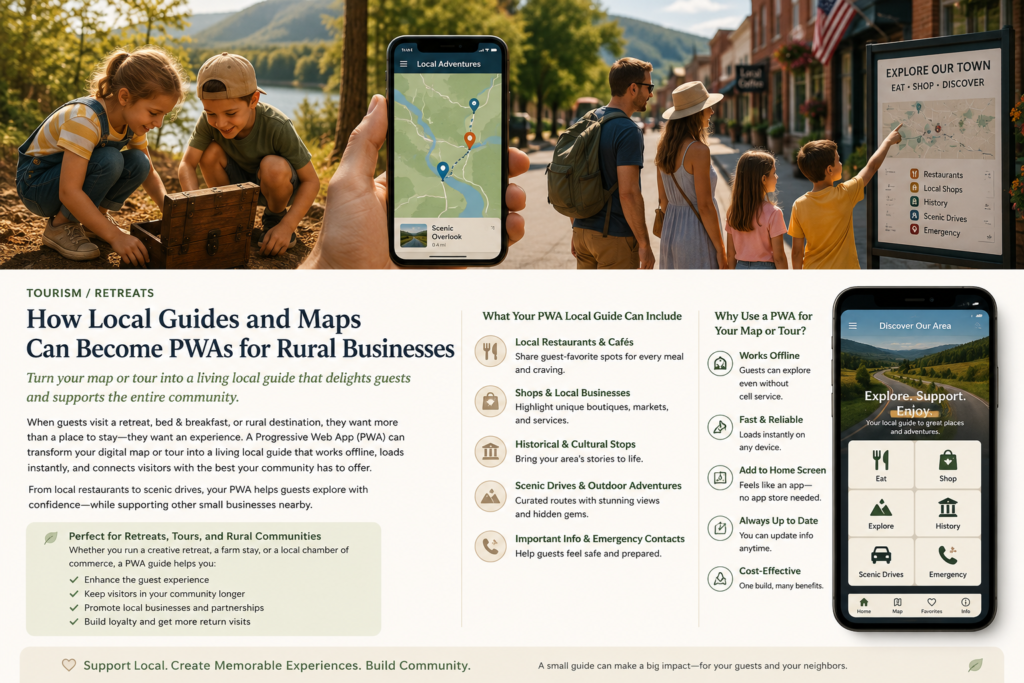
In rural tourism, the experience doesn’t stop at the front gate of a retreat center, campground, lodge, or farm stay. Guests want to explore. They want to find the hidden coffee shop, the scenic overlook, the antique store tucked away on a side road, and the local restaurant everyone recommends after sunset.
For many rural businesses, helping visitors discover the surrounding community is already part of the guest experience. The challenge is making that information accessible, useful, and easy to update without forcing guests to download a complicated app or rely on paper brochures.
That’s where Progressive Web Apps (PWAs) can completely change the experience.
A PWA turns a digital map, local guide, or tour experience into a lightweight app-like platform guests can open instantly from their phone browser. It works across devices, can be saved to the home screen, often functions offline, and creates a modern local guide experience without the cost or friction of building a traditional mobile app.
For retreats, tourism groups, chambers of commerce, tour operators, and rural destinations, PWAs offer a practical way to improve guest experiences while supporting nearby small businesses at the same time.
What Is a PWA?
A Progressive Web App is a website that behaves like a mobile application. Instead of requiring users to visit an app store, download software, create accounts, and manage updates, a PWA launches directly from a link.
- Open the guide instantly from a QR code
- Save it to their phone home screen
- Access maps and recommendations quickly
- Use it during travel with limited connectivity
- Receive updated content automatically
Unlike traditional tourism apps that become outdated or unused after one trip, PWAs reduce friction. Visitors can start using the experience immediately.
Rural Tourism Depends on Local Discovery
Creative retreats, wellness destinations, agritourism properties, hiking lodges, and small-town tourism groups all share a common goal: helping guests connect with the area.
Visitors are rarely looking for only one destination anymore. They want experiences.
- Nearby restaurants
- Scenic drives
- Family-friendly activities
- Historical landmarks
- Outdoor recreation
- Emergency services
- Shopping districts
- Seasonal festivals
A local tourism PWA can organize everything into one connected experience.
A Retreat Can Become a Local Discovery Hub
One of the biggest opportunities for rural businesses is becoming a gateway into the surrounding community.
Imagine a creative retreat center that sends guests into town for a local discovery challenge. Families use an interactive map to find murals, hidden landmarks, local bakeries, or historical stops. Kids participate in digital scavenger hunts using GPS-enabled check-ins. Guests earn rewards or discounts from participating businesses.
Instead of simply hosting visitors, the retreat becomes part of a larger community ecosystem.
Why PWAs Work Well for Rural Destinations
Easy Access
Visitors scan a QR code from a welcome packet, sign, brochure, cabin wall, or visitor center. The guide opens instantly without requiring an app store download.
Works Across Devices
A PWA works on iPhones, Android devices, tablets, and desktops, making it accessible for nearly every traveler.
Better Performance in Low-Service Areas
Many rural tourism destinations struggle with unreliable internet connectivity. PWAs can cache important information for offline access, including maps, driving directions, emergency contacts, tour routes, and business listings.
Easier Updates
Paper guides become outdated quickly. Restaurants change hours, roads close, and events move. With a PWA, updates happen instantly without reprinting materials.
Features That Make a Local Tourism PWA Valuable
- Interactive maps
- GPS-enabled walking tours
- Scenic drive routes
- Family-friendly geolocation experiences
- Emergency and safety information
- Push notifications for events and updates
- Business listings and recommendations
Families increasingly look for interactive experiences instead of passive tourism. PWAs can support treasure hunts, educational trails, seasonal events, and scavenger hunts that encourage guests to explore the community.
Supporting Small Businesses Through Shared Discovery
One of the strongest advantages of a tourism-focused PWA is that it supports the broader local economy.
A retreat center may not have a restaurant onsite, but nearby cafes benefit when guests receive curated recommendations. A chamber of commerce may not directly profit from local shopping, but the community becomes stronger when visitors spend more time exploring.
Examples include:
- A retreat recommending local coffee shops
- A farm stay promoting nearby artisan markets
- A chamber of commerce highlighting hidden attractions
- A campground featuring local fishing guides
- A historic district linking visitors to museums and cafes
Chambers of Commerce Can Modernize Local Tourism
Many chambers of commerce still rely heavily on printed directories and static websites. A PWA creates a more dynamic tourism experience through interactive town maps, event calendars, seasonal guides, local promotions, audio tours, and community announcements.
For small towns trying to attract visitors, that modern experience can make a significant difference.
Local Storytelling Matters
Tourism is emotional. People remember stories more than directions.
A good tourism PWA can tell the story of a region through historical landmarks, community history, artisan interviews, cultural experiences, and local legends. Instead of functioning like a static directory, the guide becomes a living representation of the community itself.
PWAs Are Cost-Effective for Smaller Organizations
Traditional app development often feels out of reach for rural organizations because it requires separate iOS and Android apps, ongoing maintenance, app store management, and higher development costs.
PWAs dramatically reduce complexity while still delivering a modern mobile experience.
The Future of Rural Tourism Is Interactive
Travelers increasingly expect digital convenience, even in remote destinations. They want instant recommendations, easy navigation, personalized experiences, and mobile accessibility.
For retreats, tour operators, chambers of commerce, and rural businesses, a local guide PWA can become more than a map. It becomes a living community platform that helps visitors explore, engage, and connect.
The most successful tourism experiences are no longer just destinations. They are ecosystems of local stories, businesses, people, and experiences working together.
See our comprehensive guide: PWA: The Small Business Mobile Strategy Without Native App Costs