
Why the Businesses That Stand Out Tomorrow Won’t Be the Ones Using AI the Most
There was a time when every business owner proudly bought the newest clip art collection.
Hundreds of CDs promised 10,000 royalty-free images, ready to drop into newsletters, brochures, flyers, and advertisements.
At first, it felt revolutionary.
Suddenly everyone had polished graphics. Every church bulletin, pizza menu, real estate flyer, and community newsletter looked more professional than ever before.
Then something happened.
Everything started looking the same.
The smiling businessman with the briefcase.
The woman answering a telephone.
The handshake.
The cartoon computer.
The oversized lightbulb.
You could almost identify which clip art collection someone owned just by looking at their flyer.
Today, we laugh at it.
But history has a way of repeating itself.
I believe we’re watching it happen again—with artificial intelligence.
AI Isn’t the Problem
Let’s get one thing straight.
I use AI every single day.
I couldn’t do my job as efficiently without it.
It helps me organize ideas, research complex topics, review content, brainstorm solutions, and challenge my own thinking.
AI isn’t replacing expertise.
It’s accelerating it.
The danger isn’t using AI.
The danger is letting AI become your personality.
The Internet Is Starting to Sound Like One Person
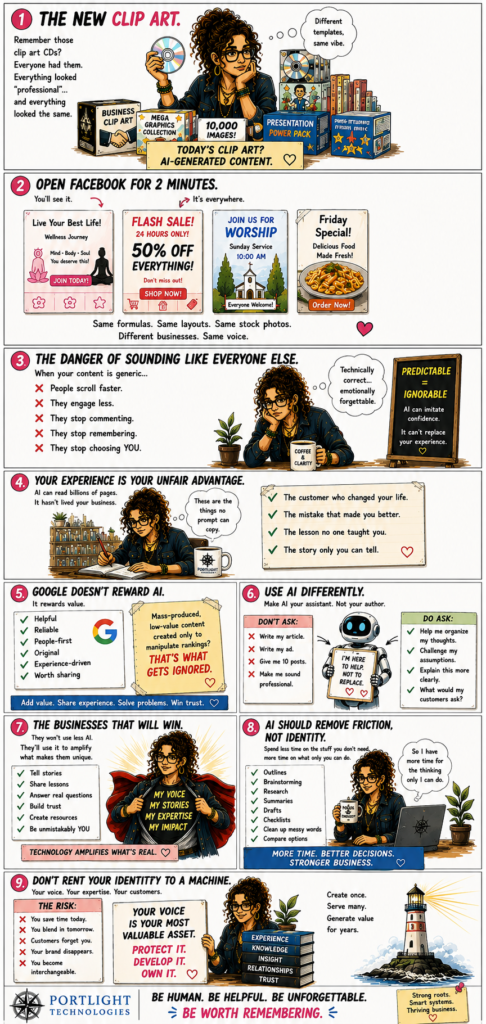
Open Facebook for five minutes.
You’ll see it.
Every post begins the same way.
Every advertisement follows the same rhythm.
Every “heartfelt” story feels strangely familiar.
Every motivational post sounds polished…
…but somehow empty.
The words are different.
The voice is identical.
It’s becoming increasingly difficult to tell one business from another because they’re all asking AI the same questions:
“Write a Facebook post.”
“Create a sales ad.”
“Write an email.”
“Make this sound professional.”
AI responds with statistically probable language.
That means millions of businesses are producing statistically similar content.
The internet is slowly becoming beige.
The New Clip Art
The first generation of desktop publishing had clip art.
The first generation of AI marketing has “AI voice.”
Neither is inherently bad.
The problem begins when everyone uses it exactly the same way.
Think about those old flyers.
The graphics weren’t wrong.
They were simply overused.
Eventually, they became a signal that very little original thinking had gone into the piece.
I think we’re already seeing the same thing happen with AI.
You don’t even have to finish reading a post before your brain says,
“I’ve read this before.”
Maybe you haven’t.
Maybe it was another business.
Maybe another industry.
Maybe another city.
But the structure…
The transitions…
The inspirational ending…
The tidy bullet lists…
They’ve all begun blending together.
The Cost of Sounding Like Everyone Else
When your content sounds like everyone else’s, something subtle begins to happen.
People scroll faster.
They engage less.
They stop commenting.
They stop remembering who wrote it.
Not because the writing is bad.
Because it doesn’t belong to anyone.
It’s generic.
The greatest danger of AI isn’t that it writes poorly.
It’s that it writes predictably.
Your Experience Is the One Thing AI Cannot Manufacture
AI has read billions of pages.
It has not lived your business.
It doesn’t know:
The customer who completely changed your perspective.
The project that almost failed—and what you learned from it.
The lesson you wish someone had taught you ten years ago.
The mistake that made you better.
The conversation that reshaped your business.
Those stories are yours.
Those experiences are your competitive advantage.
No prompt can recreate them.
Google Isn’t Looking for AI.
It’s Looking for Value.
One of the biggest misconceptions online is that Google somehow “punishes AI.”
That’s not what Google says.
Google has consistently emphasized that it rewards helpful, reliable, people-first content, regardless of whether AI helped create it. What it discourages is mass-produced, low-value content created primarily to manipulate search rankings.
In fact, Google’s more recent guidance for AI search continues to emphasize creating non-commodity content—content with unique viewpoints, first-hand experience, and genuine value rather than summaries that anyone (or any AI) could produce.
That’s an important distinction.
The issue isn’t AI.
The issue is becoming interchangeable.
Stop Asking AI to Think For You
The businesses getting the greatest value from AI aren’t asking it to create their business.
They’re asking it to improve it.
Instead of:
“Write my article.”
Try:
“Here’s my experience. Help me organize it.”
Instead of:
“Write a sales page.”
Try:
“Here’s why my clients succeed. Help me explain it more clearly.”
Instead of:
“Create ten Facebook posts.”
Try:
“Challenge my assumptions. What questions would my customers ask?”
AI becomes an editor.
A researcher.
A sounding board.
Not your replacement.
The Businesses That Will Win
Five years from now, I don’t think people will remember which businesses used AI.
They’ll remember which businesses remained unmistakably human.
The ones that told stories.
Shared lessons.
Documented experience.
Answered real questions.
Built trust.
Developed recognizable voices.
Created resources worth saving.
Those businesses won’t use AI less.
They’ll simply use it differently.
Technology will amplify what makes them unique rather than replace it.
The Portlight Philosophy
At Portlight Technologies, I don’t believe AI should replace your voice.
I believe it should remove the repetitive work that keeps you from using it.
Use AI to organize.
Use AI to brainstorm.
Use AI to refine.
Use AI to challenge your thinking.
But don’t ask it to become the expert.
That’s your job.
Your experience.
Your perspective.
Your stories.
Your judgment.
Those are the assets your competitors can’t copy.
And in a world where thousands of businesses are beginning to sound exactly alike, your authentic voice may become your single greatest competitive advantage.
Because clip art didn’t destroy great design.
It simply made originality more valuable.
AI won’t destroy great businesses.
It will make genuine expertise, unmistakable personality, and original thinking more valuable than ever.